France Real Estate: Urban Decline, Suburban Growth
Explore the evolving landscape of France's real estate market as city prices drop and demand for garden homes in suburbs rises post-Covid.
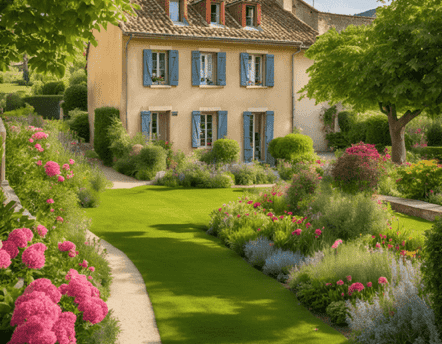
As the real estate landscape continues to evolve, a curious dichotomy emerges: while urban centers grapple with declining property values, their surrounding municipalities are witnessing a notable uptick in prices. This phenomenon, which began to take shape during the pandemic, has rendered the quintessential house with a garden increasingly appealing. Could this signify a seismic shift in the demographic balance, favoring the peripheries over the once-coveted city centers?
As winter approaches, the real estate market appears to have entered a state of hibernation, with prices mirroring the trends observed in the preceding month, as indicated by our Bien'Ici - BFM Business barometer, which meticulously analyzes advertisement prices prior to negotiations. Major cities have experienced a continued decline, with Bordeaux and Nantes recording a decrease of 0.5%, Strasbourg at 0.3%, and Grenoble and Marseille both at 0.2%. Conversely, a slight upward inflection has been noted in other locales, with Angers rising by 0.4%, Lyon by 0.3%, and Montpellier by 0.2%. Nevertheless, it is crucial to highlight that, overall, prices remain down by a staggering 5 to 7% in the majority of large urban centers compared to 2023.
Despite this apparent tranquility, a fundamental trend is surfacing. While the major cities continue their downward trajectory, the surrounding municipalities are either stabilizing or experiencing modest increases. For instance, near Lille, property prices have remained steady, with slight increases in Lambersart (+3%) and Marquette-lez-Lille (+1%), according to data from Bien'ici. Similarly, in the vicinity of Nantes, municipalities such as Basse-Goulaine (+3%), La Chapelle sur Erdre (+4%), and notably Saint-Aignan Grandlieu (+8%) have seen their prices ascend over the past year. To the east of Montpellier, the municipalities of Saint-Georges d'Orques and Laverune have posted an impressive increase of approximately +10% over the same period.
This burgeoning interest in relatively accessible locales, where commuting times remain reasonable, suggests a potential recovery in the real estate market. As demand surges, so too do prices. Seloger corroborates this trend, noting a divergent evolution in the pricing of houses versus apartments. Since the summer, a decline in interest rates and property prices, coupled with banks' enticing strategies to attract new clientele, has fostered a climate ripe for recovery. However, since the onset of the academic year, apartment prices have dipped by 0.7%, while house prices have seen a modest increase of 0.1%, as per SeLoger’s data.
On the rental front, a resurgence in prices is evident across the majority of cities surveyed, following a brief lull last month. This month, rents have risen in all major urban centers, with the notable exceptions of Lyon and Paris. Strasbourg has emerged as the frontrunner in this upward trend, boasting a remarkable increase of 5.7% compared to the previous month.
As we navigate this intricate tapestry of real estate dynamics, it becomes increasingly clear that the interplay between urban decline and suburban allure is reshaping the market in unforeseen ways. The question remains: will this trend continue to gain momentum, or will the pendulum swing back towards the city centers? Only time will tell.